Tacet County
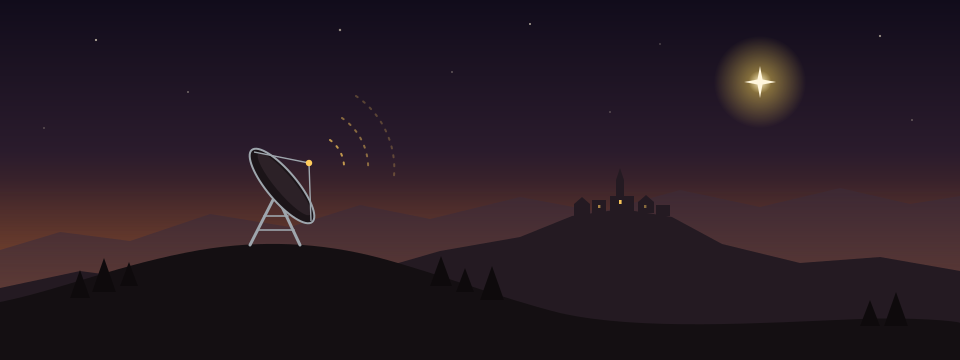
Up in the mountains there is a valley where radio is against the law. For decades no transmitter has been allowed inside it, to keep the air quiet for two listening posts: the radio observatory on Lantern Knob, the first place anyone ever turned a dish to the sky to listen for someone else, and Still Run, a government intercept station in the hollow across the valley, whose trade is copying other people's signals.
The county is called Tacet: the mark in a piece of music that tells a player to stay silent for the whole passage.
Selah
Then the answer came, to the first place that ever listened. Both dishes caught it on the same night, and both decoded it before morning.
The station staff named it Selah, after a word in the Psalms nobody can translate, usually read as pause, and listen. It was not a message. It was a blueprint. Both stations followed its instructions, and both built what it describes.
The echoes
What they built is a pattern, and it borrows whatever is near: fallen leaves in autumn, snow and ice in winter, mud in spring, grass and flowers in summer. Radio noise breaks it. Inside the quiet zone the things walk; carried outside, one falls apart into a heap of whatever it was made of.
They learned from the soldiers who raised them, and they copy them. They cross the valley in waves, charge like the people who charged and aim like the people who aimed. They copy faces too, which is why every soldier in the valley keeps theirs behind a balaclava and goggles. The soldiers call them echoes: they copy us, and they are a reply.
Every echo carries a core in its chest, the signal made visible through its leaves or snow or mud, glowing in its side's colour. When one dies the core bursts, and the body sinks back into the ground it was made from.
Hail and Hush
Each station's echoes learned what their builders wanted. The observatory's are building a reply: we're here.
Still Run's learned the intercept trade. They copy the observatory's reply exactly as it is written and build the same signal turned upside down. Sent together on the one frequency, the two cancel to nothing, the way noise-cancelling headphones do. That is silence, not noise, so it breaks no echo. And silence is the only answer that says nothing at all: even nobody is here would tell the sender that someone is.
While both great dishes stand, the valley stays silent. So one has to fall. If Still Run's dish falls, nothing cancels the reply and it goes out: first contact. If Lantern Knob's falls, there is no reply left to send.
Hail
Lantern Knob's half. To hail is to call out to someone. They mean to be heard, and they are coming for Still Run's dish.
Hush
Still Run's half. To hush is to quiet someone. A silence held by a mirror lasts only while the mirror stands, so they are coming for Lantern Knob's.
Neither side is the villain. One believes in answering; the other believes silence is the only safe answer. You fight for whichever side the match puts you on.
Task Force 1420
A single federal task force sealed the zone and took both stations. Nothing is radioed in or out, because any transmission breaks the echoes, so orders come by courier and the two station commanders are on their own. Over the weeks each half of the task force came to trust the echoes at its own station, and the task force split down the middle. Nobody outside can stop it, and nobody inside can jam the other side: noise would break their own echoes too.
Both halves wear the one kit, so each marks itself with coloured tape on its arms and helmets, the luminous kind soldiers sew on to follow each other in the dark. Their gear is analogue, because radios are banned: field telephones on wire, paper maps, flare guns, film cameras.
The number is the hydrogen line, 1420 MHz, the frequency the first search for another voice listened on. The patch on every shoulder reads 21 cm, its wavelength.
Vesper
Between the two stations, on a peak at the very centre of the valley, sits Vesper, an old ski village, evacuated: a general store, a school, a church, and payphones, because a mobile phone has never had a signal here. It is named for the evening star, the first light in the sky at dusk, seen first from a peak.
Two passes run through the mountains from station to station, one along each side of the valley. Under the town a spring rises in a cave and runs out both ways, and the town's church stands right over it.
The strays
The signal reached living animals too. No station raised these, and they belong to neither side: they turn on whoever comes near. Each one's lair sits where something focuses the signal, an old dish, a cave, a spring. When a stray dies its core sinks into the ground, and a few minutes later the pattern takes another animal in the same place.
Whoever lands the last hit is splashed by the core and carries the signal for a while, glowing faintly, so the other side can see who to hunt. The strangest of them is a huge moth drawn to the dishes, nesting in an old dish that fell through a hillside.